Variables
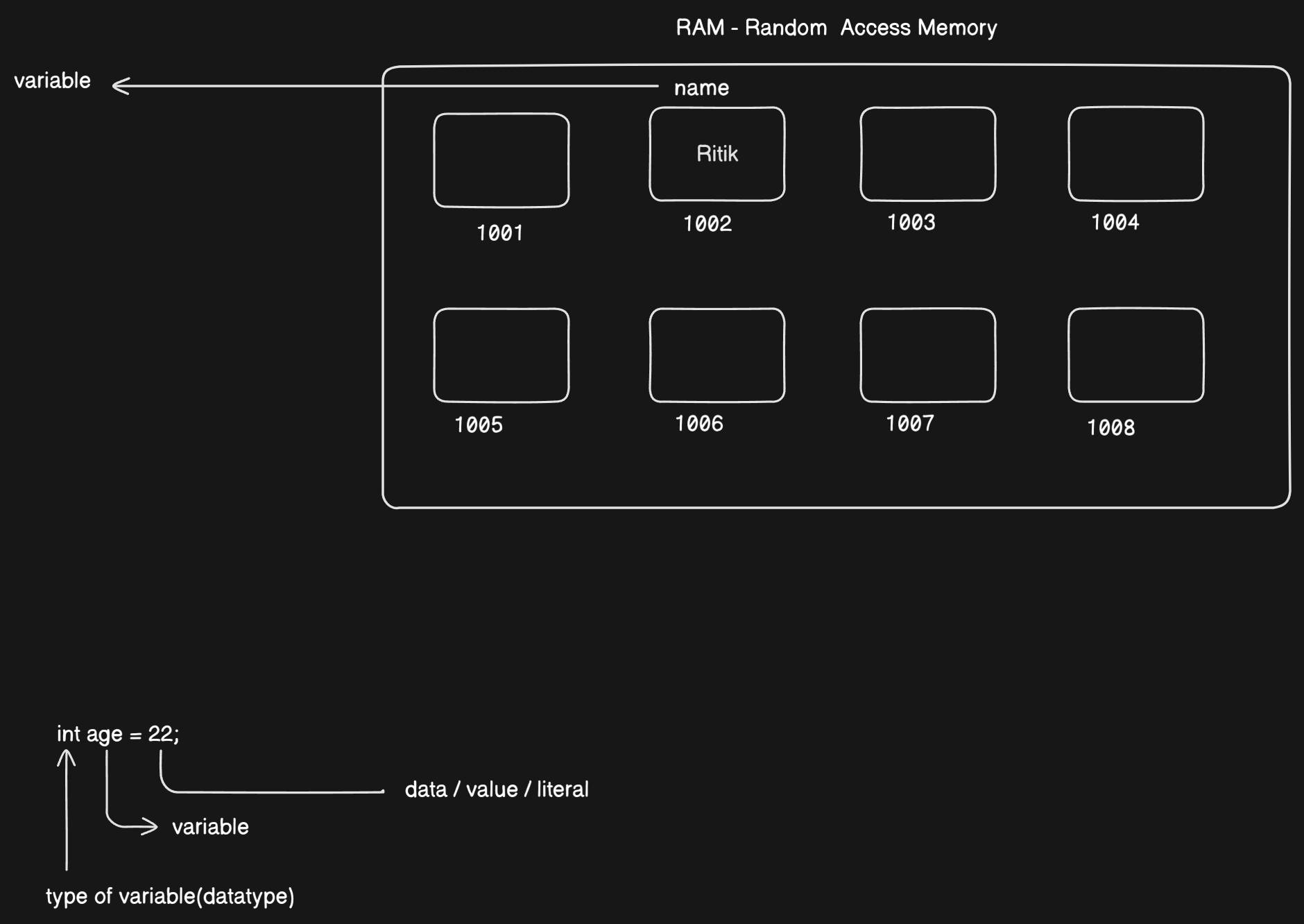
Memory Locations:
Variables in a computer program are like "wells" where data is stored. These "wells" have names, which are the variable names. The purpose of these variables is to store and retrieve data efficiently.
Java and Strong Typing
Java is a strongly typed programming language, which means that you must define the type of each variable before using it.
Why is this important?
- In Java, you need to specify the data type of a variable at the time of declaration.
- This ensures that the compiler knows what kind of data (like integers, text, etc.) the variable will store and helps avoid errors during the execution.
Example:
int age = 25;   // 'int' is the data type that stores whole numbers
String name = "John";  // 'String' is the data type that stores text
Operators
Operators are symbols that perform operations on variables and values. In Java, they are categorized into:
- Unary Operators
- Binary Operators
- Ternary Operator
Unary Operators
Work with one operand to perform operations like incrementing, negating, etc.
Examples:
-
Pre-Increment (
++x): Increments before useint x = 5;
int y = ++x; // y = 6, x = 6 -
Post-Increment (
x++): Increments after useint x = 5;
int y = x++; // y = 5, x = 6 -
Unary Minus (
-x): Negates the value -
Unary Plus (
+x): Indicates a positive value (often implicit)
Binary Operators
Operate on two operands. Commonly used for arithmetic, relational, and logical operations.
Arithmetic Operators:
int result;
result = 5 + 3; // Addition: result = 8
result = 5 - 3; // Subtraction: result = 2
result = 5 * 3; // Multiplication: result = 15
result = 6 / 3; // Division: result = 2
result = 5 % 3; // Modulus: result = 2
Relational Operators:
boolean result;
result = 5 > 3;  // true
result = 5 < 3;  // false
result = 5 >= 5; // true
result = 5 <= 3; // false
result = 5 == 5; // true
result = 5 != 3; // true
Logical Operators:
boolean result;
result = true && false; // Logical AND: false
result = true || false; // Logical OR: true
result = !true;         // Logical NOT: false
Ternary Operator
A shorthand for if-else, works with three operands.
Syntax:
condition ? value_if_true : value_if_false;
Example:
int age = 18;
String result = (age >= 18) ? "Adult" : "Minor"; // "Adult"
If the condition is true, returns "Adult"; otherwise, returns "Minor".
Java Data Types
What are Data Types?
Data types in Java define the type of data that a variable can hold. They specify the size and type of values that can be stored in variables.
Java data types are divided into two broad categories:
- Primitive Data Types
- Non-Primitive Data Types
Primitive Data Types
These are the most basic data types built into the language.
Integer Types (Sorted by Size)
- byte: 1 byte = 8 bits → Range: -128 to 127
- short: 2 bytes = 16 bits → Range: -32,768 to 32,767
- int: 4 bytes = 32 bits → Range: -2³¹ to 2³¹ - 1
- long: 8 bytes = 64 bits → Range: -2⁶³ to 2⁶³ - 1
Floating Point (Real Number) Types
- float: 4 bytes → Approximate precision of 6-7 decimal digits
- double: 8 bytes → Approximate precision of 15 decimal digits
🔴 Note: Real number literals (e.g.
3.14) are considereddoubleby default. To assign them tofloat, either cast or addf/Fsuffix.
float num = (float)3.14;
float num = 3.14f;
Other Primitive Types
-
boolean: 1 bit (conceptual) → Values:
trueorfalse- ❌ Cannot participate in type casting
-
char: 2 bytes → Stores a single Unicode character (e.g.,
'A','a')
Non-Primitive Data Types
These are more complex and include:
- Arrays
- Strings (inbuilt class)
- Classes (user-defined)
- Interfaces
These types are used for handling objects and complex structures.
Type Casting in Java
Type casting is converting a variable from one data type to another.
Implicit Casting (Widening Conversion)
- Converts a smaller size type to a larger size type.
- Happens automatically.
- No data loss.
int a = 10;
long b = a;        // int to long
float c = b;       // long to float
Explicit Casting (Narrowing Conversion)
- Converts a larger size type to a smaller size type.
- Requires manual casting.
- Possible data loss.
double a = 10.5;
int b = (int) a;   // double to int, fractional part lost
🔴 Note: Boolean type cannot be cast to/from any other type.
Additional Notes
-
The main method is the entry point of a Java program.
public static void main(String[] args) -
Execution starts from the JVM, which calls the
main()method. -
Suffixes:
- Use
forFforfloatliterals - Use
lorLforlongliterals (recommended to useLto avoid confusion with1)
- Use